
5-Inch vs. 6-Inch Gutters for Connecticut Homes
Published and reviewed by We Gutter LLC, a Connecticut gutter service company.
What is the key takeaway?
Six-inch gutters are not automatically better for every home. Roof area, pitch, valleys, rainfall, downspout capacity, fascia space and the source of existing overflow should determine the design.
Quick answer: which gutter size is right?
Five-inch gutters may be appropriate for many straightforward residential roof sections. Six-inch gutters deserve consideration where larger or steeper roof areas, long runs, concentrated valleys or repeated heavy-rain overflow create greater demand. The choice should be calculated with the outlets and downspouts, not made from gutter width alone.
What actually determines gutter size
- Roof area draining into each gutter run
- Roof pitch and how quickly runoff reaches the edge
- Valleys and upper-roof discharges that concentrate water
- Local rainfall design criteria
- Gutter length, pitch and number of outlets
- Downspout size, bends and final discharge conditions
- Available fascia space and the relationship to the roof edge
Connecticut's residential code addresses roof drainage as a system. See Chapter 33 of the 2022 Connecticut State Building Code for the governing framework; an installer or designer must apply relevant local requirements to the property.
Side-by-side comparison
| Question | 5-inch gutter | 6-inch gutter |
|---|---|---|
| Typical visual scale | More compact | Larger profile |
| Potential water capacity | Lower | Higher when paired with suitable outlets and downspouts |
| Material and installation cost | Usually lower | Usually higher |
| Best use | Simpler, lower-demand roof sections | Larger or high-runoff sections after assessment |
| Guaranteed to solve overflow? | No | No |
Avoid universal percentage claims about capacity unless the manufacturer provides tested data for the exact profile, slope, outlets and downspouts being quoted.
When six-inch gutters deserve a closer look
A large roof plane feeds one run
The plan-view roof area matters more than the home's floor area. An addition, garage or multi-level roof can send more water to one elevation than another.
A valley repeatedly overshoots the edge
A valley can concentrate runoff into a short area. The full correction may include a larger receiving gutter, relocated outlet, additional downspout or properly designed diverter.
The system is clean and pitched but still overflows
After ruling out clogs, damaged hangers, guard buildup and discharge restrictions, recurring overflow can justify a capacity calculation and layout change.
The home is already receiving replacement gutters
Replacement is the best time to compare sizes because outlets, downspouts, hangers and the complete layout can be designed together.
When a larger gutter will not solve the problem
A six-inch channel cannot overcome a blocked elbow, clogged underground pipe, reverse pitch, loose fascia, badly placed outlet or water passing over a debris-covered guard. Diagnose the failure during or soon after rain before changing size.
What to ask on an installation estimate
- Which roof areas drain to each proposed gutter run?
- Why is the proposed size appropriate for those areas?
- What outlet and downspout sizes are included?
- Will downspout locations change?
- How will valleys and upper-roof discharges be handled?
- Where will the water go at ground level?
- What material thickness, hanger spacing and warranty are included?
An estimate should explain the design rather than simply label six-inch gutters as an upgrade.
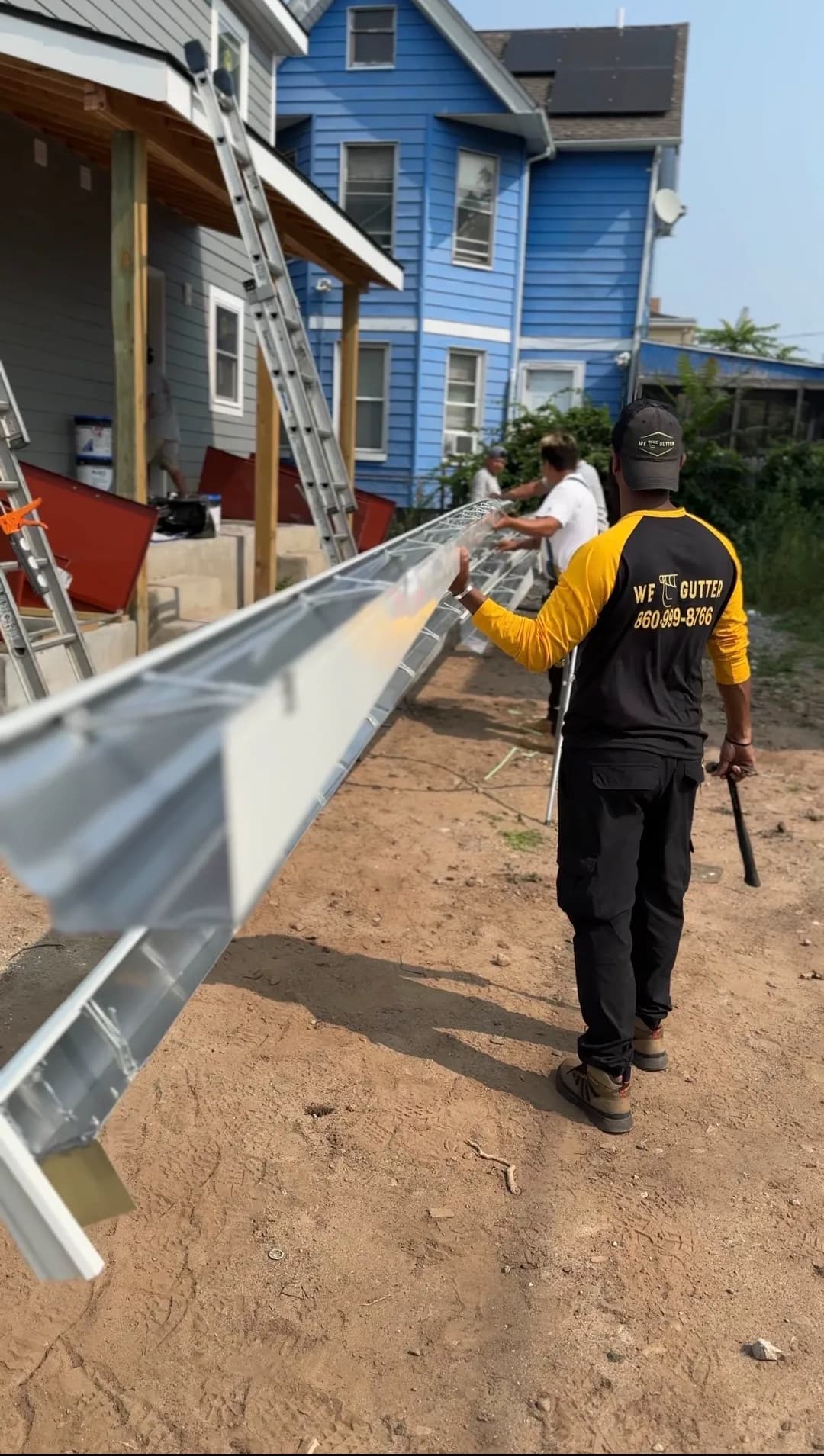
We Gutter fabricates seamless aluminum gutters on site and evaluates each roofline, drainage path and problem area before recommending a size. For a property-specific comparison in Waterbury, Naugatuck, Wolcott, Watertown, Southbury or nearby communities, request an on-site estimate.
*Published and reviewed by We Gutter LLC on August 13, 2026. Gutter sizing and code compliance depend on the specific building and local requirements.*
Frequently Asked Questions
Are six-inch gutters better than five-inch gutters?
They offer a larger channel, but the best system is the one sized for the roof and paired with suitable outlets and downspouts. A larger gutter will not fix a clog, reverse pitch or poor discharge path.
Do six-inch gutters need larger downspouts?
A high-capacity design normally considers the outlets and downspouts together with the gutter. Restricting a larger channel through undersized or poorly placed outlets can limit the expected benefit.
Can only one high-runoff section be upgraded?
Sometimes a problem area can be redesigned independently, but transitions, appearance, roof geometry and the complete discharge path must be evaluated before mixing components.
Will larger gutters prevent every overflow?
No. Debris, a clogged downspout, incorrect pitch, guard buildup, roof-valley overshoot or blocked underground drainage can still cause overflow.